These are the slides from a talk Nathan Nobis recently did for the Atlanta Science Tavern that addressed some ethical issues concerning animals:
Saturday, July 4, 2009

Friday, April 3, 2009
Cherry-Picking Our Scientific Data
Yesterday I read a news story reporting on findings by a research team at Queen’s University Belfast in the prestigious journal Animal Behaviour providing evidence that hermit crabs feel pain and remember it. That is, there is a cognitive component to their reaction to various stimuli. To those who have witnessed the screams of lobsters dropped into pots of boiling water or take as an assumption that having a nervous system has something to do with feeling and perceiving… well, this is not news. But for those who demand their beliefs be based on objective scientific data… it is a revelation I suppose.
Okay, well, what do we do now? Those of us in science have spent lifetimes teaching our students that the beauty of the scientific enterprise is that it is self-correcting and adjusts conceptually to incoming data. Yet, there seems to be no response to the above findings. Of course this silence is just a microcosm of the broader stance that we take towards “inconvenient truths” – we ignore them. We have an overwhelming amount of evidence that other mammals feel pain and distress and yet we don’t take those findings into account when eating them, experimenting on them (to get even more data!), and poaching them. So why am I all bent out of shape (coming out of my shell) about hermit crabs? Two reasons.
One is that, despite the loose protections in existence for mammals and (some) vertebrates there is no protection against pain and suffering for invertebrates such as hermit crabs. There is not even an Animal Welfare Act to minimally guide how we treat them nor any substantive discussion of whether we should give them the benefit of the doubt. Up to now even the most empirically-minded scientists might have appealed to the fact that there was no clear evidence for the conscious experience of pain in invertebrates. Now their hand is forced because of these new data.
Two is the very unscientific nature of our response. The scientific study of other animals as models for human conditions is done from a cherry-picker. We use rats in depression research but refuse to acknowledge the very data that makes them valid subjects in such research. We use monkeys in studies of horrific neurological disorders that cause tremendous suffering in people yet choose to ignore the data that they are just as debilitated by these diseases as we are. And on and on. It is fair to say that our propensity to “keep the good data and throw out the bad data” is so imbedded in the scientific process that we are barely aware we are doing it at this point.
It will be interesting to see if the scientific community responds in the manner we prescribe for our students (to adjust to changing evidence) or whether we decide to, as we always have, cherry-pick those data that are consistent with our professional and personal objectives from those that represent an authentic challenge to our role as scholars and human beings. I wonder. How many of us will engage in a parlor debate over this issue at the seafood buffet?
Okay, well, what do we do now? Those of us in science have spent lifetimes teaching our students that the beauty of the scientific enterprise is that it is self-correcting and adjusts conceptually to incoming data. Yet, there seems to be no response to the above findings. Of course this silence is just a microcosm of the broader stance that we take towards “inconvenient truths” – we ignore them. We have an overwhelming amount of evidence that other mammals feel pain and distress and yet we don’t take those findings into account when eating them, experimenting on them (to get even more data!), and poaching them. So why am I all bent out of shape (coming out of my shell) about hermit crabs? Two reasons.
One is that, despite the loose protections in existence for mammals and (some) vertebrates there is no protection against pain and suffering for invertebrates such as hermit crabs. There is not even an Animal Welfare Act to minimally guide how we treat them nor any substantive discussion of whether we should give them the benefit of the doubt. Up to now even the most empirically-minded scientists might have appealed to the fact that there was no clear evidence for the conscious experience of pain in invertebrates. Now their hand is forced because of these new data.
Two is the very unscientific nature of our response. The scientific study of other animals as models for human conditions is done from a cherry-picker. We use rats in depression research but refuse to acknowledge the very data that makes them valid subjects in such research. We use monkeys in studies of horrific neurological disorders that cause tremendous suffering in people yet choose to ignore the data that they are just as debilitated by these diseases as we are. And on and on. It is fair to say that our propensity to “keep the good data and throw out the bad data” is so imbedded in the scientific process that we are barely aware we are doing it at this point.
It will be interesting to see if the scientific community responds in the manner we prescribe for our students (to adjust to changing evidence) or whether we decide to, as we always have, cherry-pick those data that are consistent with our professional and personal objectives from those that represent an authentic challenge to our role as scholars and human beings. I wonder. How many of us will engage in a parlor debate over this issue at the seafood buffet?
Wednesday, March 11, 2009
Planet of the Apes Redux
By Lori Marino
As I read about the recent story of Santino, the chimpanzee at the Furuvik zoo in Sweden who was throwing stone disks at visitors I could not help but be taken back to the classic movie Planet Of The Apes. Santino is being given all this attention because he is planning his behavior, choosing, modifying and stockpiling appropriate rocks during the evening for throwing the next day when visitors are around. This obvious instance of foreplanning has sent shock waves through the scientific community because planning ahead is supposed to be a distinctly human trait and Santino is apparently in possession of it. Here’s the part that is like Planet Of The Apes. In the movie Charlton Heston is captured, collared, and confined by great apes who consider Heston “an animal”. When he tries to talk and show similar cognitive abilities to the apes their response, led by a close-minded orangutan named Dr. Zaius, is to silence him by threatening castration or a frontal lobotomy. All because they are deathly afraid of the obvious – that Heston thinks and feels the way they do. The implication is that if they admit this, their treatment of him is nothing short of immoral and they have to change.
This scenario was played out in real life in the case of Santino. The zoo’s response to his agitated behavior? Castration. They imagine this will make him more docile and less motivated to throw stones. It may work. But that is not the issue. It reminds me of the old, pre-Civil War diagnosis of "drapetomania" - the "psychiatric" disorder "possessed" by slaves who tried repeatedly to run away from their “owners”. Rather than listen to those who are imprisoned, we so often prefer to malign them, which is a good way of reducing the discomfort of cognitive dissonance.
The focus of attention on Santino is driven by the psychological traits he shares with us, and yet, the response of the human great apes is stunningly inconsistent with that fact. Like the apes in the movie, we avoid the obvious and try to “keep him quiet” with invasive procedures. There is no apparent attempt to use this discovery as the occasion for considering the fact that Santino might actually have a point. There is apparently no recognition of the fact that Santino is communicating loud and clear that he does not want to be in a zoo watched by unfamiliar people all day. Must he wear a sign? The author of the report , Mathias Osvath, in Current Biology (Vol 19, Issue 5, R190-R191, 10 March 2009) states that "These observations convincingly show that our fellow apes do consider the future in a very complex way,". He adds that "It implies that they have a highly developed consciousness, including lifelike mental simulations of potential events." Yet, apparently this discovery warrants a review of a scientific paper but not a review of how Santino is being treated.
The time has come for us to listen to these beings who are expressing their feelings about captivity and their experiences. They may not speak the words in English or some other human language but the message is obvious. We can, like the “hear no evil, see no evil, speak no evil” apes in the movie, choose to suppress the obvious with strong-arm tactics or we can choose the truly educated and enlightened path and listen to what Santino and his kin are telling us. The choice is ours.
At the end of the movie Dr. Zaius discovers a human doll that talks. It says’ “mama” and he knows the justification for his treatment of human apes is crumbling before him. Well, we have heard our “mama” in the form of Santino’s stone throwing. The question is whether we will answer our fellow great ape with consistency in thought and compassion or, as Dr. Zaius does in the end of the movie, blow up the mine and forever seal the truth and our fates.
Sunday, December 14, 2008
This blog will appear in edited form in the Los Angeles Times Blowback section on Monday, December 15, 2008.
Zoos without elephants would be a lesson in compassion for the children of L.A.
Neuroscience and Behavioral Biology Program
Gay Bradshaw, Ph.D., Ph.D.
The
Randy Malamud, Ph.D.
Department of English
In his recent article entitled “Zoos without elephants would be a loss for the children of In light of the mountain of evidence that has accumulated over the past three decades showing the extensive and profoundly adverse effects of animals’ emotions on their physical health, this is not at all surprising.
Elephants share common brain structures and functions with us. They recognize themselves in mirrors and thus share a similar sense of self with us. Elephants also suffer from the stress of forced incarceration, physical deprivation, social isolation and other trauma. Consequently, when children see Billy they are looking at someone not too much different from the children they see on the news who are victims of war and genocide—sentenced to live without family and friends under harsh conditions resembling a prison.
Tobar claims he is concerned about the impact of losing the elephant exhibit on children. In doing so he attempts to frame the issue as “elephants versus children”. He knows better than that. He knows that there are many things that his and other children will never experience. Most children do not grow up to pet a dinosaur (indeed none do!), climb Mt. Everest, or dance in the American Ballet Theater. And Mr. Tobar knows that no child suffers because of lack of these experiences. They will grow up to lead happy meaningful lives without these experiences. The same is true of seeing elephants in zoos.
Brenda McCowan, Ph.D., Assoc. Professor, School of Veterinary Medicine, University of California, Davis
Kenneth Shapiro, PhD, ABPP, Executive Director. Animals & Society Institute
Wednesday, December 3, 2008
Recreational conservation
As I read about these touted efforts to bring back extinct species I envision a dystopic future that repeats the ignorance and abuses of the past. In 1902 the
Thursday, February 14, 2008
Whale sharks turned into carnival ride
Georgia Aquarium endangering its animals with new program
Published on: 02/14/08

Georgia Aquarium endangering its animals with new program
Published on: 02/14/08
Recently, the Georgia Aquarium sponsored a contest whereby visitors won a chance to swim or dive with the whale sharks. In fact, NBC touted this exploit on "Today," showing the three winners diving in the tank with the whale sharks. Now the aquarium has announced an ongoing program to provide paying customers an opportunity to swim with these animals.
We are disturbed that, after the deaths last year of two whale sharks in its charge, Ralph and Norton, the Georgia Aquarium has so little concern for the welfare of the remaining animals. A careful professional stance would have been for the Georgia Aquarium to minimize all possible negative impacts on the remaining sharks in order to maximize their chances of survival, which, we already know from Asian aquariums, are not good in captivity.
 John Spink/Staff |
| 'Today' (with Meredith Vieira) brought its cameras to the Georgia Aquarium on Tuesday, when winners of a contest with the prize of swimming with the whale sharks were announced. Allowing people to swim with the sharks stresses and endangers the animals, the writers say. |
Instead, the Georgia Aquarium chose to promote a highly commercial circus atmosphere and make the animals into an amusement park ride. How could anyone concerned about the welfare of these animals support the risks of contamination and stress associated with having people (who may carry diseases and germs) invade these animals' delicate environment? While divers in the Pacific occasionally swim alongside whale sharks, entering the enclosed space of captive animals has very different implications and consequences for the animals, who have no escape.
We wonder if anyone at the aquarium has considered the psychological effects of this intrusion into the whale sharks' already compromised personal space.
On its Web site the aquarium presents 25 frequently asked questions about the dive program. We would add one more: How do you think the animals feel about the paying guests who pop into their water every afternoon?
The aquarium markets this contest as a way to educate the public and preserve whale sharks. The sincerity of this claim is belied by the blatant exploitation of these animals at a price of $190 to $290 a swim or dive for nonmembers.
The aquarium has produced no credible evidence supporting the claim that visits to their whale shark exhibit (or any other exhibit, for that matter) translate into better understanding of whale sharks (or any other species). Also, there is no evidence that swimming with captive animals (such as fish and mammals) increases understanding and appreciation for them. Even if there were such evidence, would it be a risk worth taking?
Whale sharks live in deep water, swim for hundreds of miles to feed and mate, and do not typically interact with people. It seems to us that the truly important conservation message that people need to learn is how to value these animals without needing to commodify them.
P.T. Barnum once said, "Clowns and elephants are the pegs on which the circus is hung." Were he alive today and in Atlanta, he might add "30-foot sharks" to his equation.
— Lori Marino is a senior lecturer at Emory University's Neuroscience and Behavioral Biology program. Randy Malamud is professor and associate chair of Modern Literature, Ecocriticism and Cultural Studies at Georgia State University. Ron Broglio is an assistant professor in the School of Literature, Communication and Culture at Georgia Tech.
Tuesday, December 18, 2007
DOLPHIN 'THERAPY' A DANGEROUS FAD, EMORY RESEARCHERS WARN
Beverly Cox Clark: 404-712-8780, 404-275-4771 (cell), beverly.clark@emory.edu
DOLPHIN 'THERAPY' A DANGEROUS FAD, EMORY RESEARCHERS WARN
People suffering from chronic mental or physical disabilities should not resort to a dolphin "healing" experience, warn two researchers from Emory University. Lori Marino, senior lecturer in the Neuroscience and Behavioral Biology Program, has teamed with Scott Lilienfeld, professor in the Department of Psychology, to launch an educational campaign countering claims made by purveyors of what is known as dolphin-assisted therapy (DAT).
"Dolphin-assisted therapy is not a valid treatment for any disorder," says Marino, a leading dolphin and whale researcher. "We want to get the word out that it's a lose-lose situation – for people and for dolphins."
While swimming with dolphins may be a fun, novel experience, no scientific evidence exists for any long-term benefit from DAT, Marino says. She adds that people who spend thousands of dollars for DAT don't just lose out financially – they put themselves, and the dolphin, at risk of injury or infection. And they are supporting an industry that – outside of the United States – takes dolphins from the wild in a brutal process that often leaves several dolphins dead for every surviving captive.
Marino and Lilienfeld reviewed five studies published during the past eight years and found that the claims for efficacy for DAT were invalid. Their conclusions were published recently in Anthrozoös, the journal of the International Society for Anthrozoology, in a paper entitled "Dolphin-Assisted Therapy: More Flawed Data and More Flawed Conclusions."
"We found that all five studies were methodologically flawed and plagued by several threats to both internal and construct validity," wrote Marino and Lilienfeld, who conducted a similar review in 1998. "We conclude that nearly a decade following our initial review, there remains no compelling evidence that DAT is a legitimate therapy, or that it affords any more than fleeting improvements in mood."
An upcoming issue of the newsletter of the American Psychological Association's Division of Intellectual and Developmental Disabilities will feature another article by Marino and Lilienfeld, entitled "Dolphin-Assisted Therapy for Autism and Other Developmental Disorders: A Dangerous Fad."
"We want to reach psychologists with this message, because DAT is increasingly being applied to children with developmental disabilities, although there is no good evidence that it works," said Lilienfeld, a clinical psychologist. "It's hard to imagine the rationale for a technique that, at best, makes a child feel good in the short run, but could put the child at risk of harm."
The Emory scientists have timed their campaign to coincide with a recent call by two UK-based non-profits – the Whale and Dolphin Conservation Society and Research Autism – to ban the practice of DAT.
While Marino is against taking dolphins from the wild and holding them captive for any purpose, she finds DAT especially egregious, because the people who are being exploited are the most vulnerable – including desperate parents who are willing to try anything to help a child with a disability.
Many people are under the impression that dolphins would never harm a human. "In reality, injury is a very real possibility when you place a child in a tank with a 400-pound wild animal that may be traumatized from being captured," Marino says.
Dolphins are bred in captivity in U.S. marine parks, but in other countries they are often taken from the wild. "If people knew how these animals were captured, I don't think they would want to swim with them in a tank or participate in DAT," Marino says, referring to an annual "dolphin drive" in Japan. "During the dolphin drives hundreds of animals are killed, or panicked and die of heart attacks, in water that's red with their blood, while trainers from facilities around the world pick out young animals for their marine parks. They hoist them out of the water, sometimes by their tail flukes, and take them away."
Each live dolphin can bring a fisherman $50,000 or more, she says. "The marine parks make millions off of dolphins, so that's a drop in the bucket. It's an irony that dolphins are among the most beloved, and the most exploited, animals in the world," Marino says.
###
Emory University is one of the nation's leading private research universities and a member of the Association of American Universities. Known for its demanding academics, outstanding undergraduate college of arts and sciences, highly ranked professional schools and state-of-the-art research facilities, Emory is ranked as one of the country's top 20 national universities by U.S. News & World Report. In addition to its nine schools, the university encompasses The Carter Center,
Subscribe to News@Emory RSS feeds for automatic updates of the latest news at Emory.
Monday, December 10, 2007
December 10, 2007
Dolphin therapy is all wet, Emory scientists conclude
Don’t turn to a dolphin for help, warns Lori Marino.
Marino, senior lecturer in the Neuroscience and Behavioral Biology Program, has teamed with Scott Lilienfeld, associate professor of psychology, to launch an educational campaign countering claims made by purveyors of dolphin-assisted therapy.
“Dolphin-assisted therapy is not a valid treatment for any disorder,” says Marino, a leading dolphin and whale researcher. “We want to get the word out that it’s a lose-lose situation — for people and for dolphins.”
While swimming with dolphins may be a fun, novel experience, no scientific evidence exists for any long-term benefit from DAT, Marino says. She adds that people who spend thousands of dollars for a dolphin “healing” experience don’t just lose out financially — they put themselves, and the dolphin, at risk of injury or infection. And they are supporting an industry that — outside of the United States — takes dolphins from the wild, in a brutal process that often leaves several dolphins dead for every surviving captive.
Marino and Lilienfeld reviewed five studies published during the past eight years and found that the claims for efficacy for DAT were invalid. Their conclusions were published recently in Anthrozoös, the journal of the International Society for Anthrozoology, in a paper titled “Dolphin-Assisted Therapy: More Flawed Data and More Flawed Conclusions.”
“We found that all five studies were methodologically flawed and plagued by several threats to both internal and construct validity,” wrote Marino and Lilienfeld, who conducted a similar review in 1998. “We conclude that nearly a decade following our initial review, there remains no compelling evidence that DAT is a legitimate therapy, or that it affords any more than fleeting improvements in mood.”
An upcoming issue of the newsletter of the American Psychological Association’s Division of Intellectual and Developmental Disabilities will feature another article by Marino and Lilienfeld, titled “Dolphin-Assisted Therapy for Autism and Other Developmental Disorders: A Dangerous Fad.”
“We want to reach psychologists with this message, because DAT is increasingly being applied to children with developmental disabilities, although there is no good evidence that it works,” said Lilienfeld, a clinical psychologist. “It’s hard to imagine the rationale for a technique that, at best, makes a child feel good in the short run, but could put the child at risk of harm.”
The Emory scientists have timed their campaign to coincide with a recent call by two UK-based nonprofits — the Whale and Dolphin Conservation Society and Research Autism — to ban the practice of DAT.
DAT started in the 1970s, when Florida researcher Betsy Smith began experimenting with interactions between dolphins and autistic children. Smith later stopped her research, citing ethical reasons, and has since denounced the commercialization of DAT.
Florida remains the stronghold of dolphin-assisted therapy, but the trend has spread around the world, fueled by the growth in marine parks and aquariums. “DAT facilities are popping up all over — there are now hundreds of them, and no end in sight,” Marino says. “DAT is a big money-making venture and it’s merged with the swim-with-dolphins industry.”
While Marino is against taking dolphins from the wild and holding them captive for any purpose, she finds DAT especially egregious, because the people who are being exploited are the most vulnerable — including desperate parents who are willing to try anything to help a child with a disability.
Many people are under the impression that dolphins would never harm a human. “In reality, injury is a very real possibility when you place a child in a tank with a 400-pound wild animal that may be traumatized from being captured,” Marino says.
Dolphins are bred in captivity in U.S. marine parks, but in other countries they are often taken from the wild, she says. Marino describes an annual “dolphin drive” in Japan, when pods of dolphins are herded into coves, where they are killed for food or captured for marine parks.
“If people knew how these animals were captured, I don’t think they would want to swim with them in a tank or participate in DAT,” Marino says. “During the dolphin drives hundreds of animals are killed, or panicked and die of heart attacks, in water that’s red with their blood, while trainers from facilities around the world pick out young animals for their marine parks. They hoist them out of the water, sometimes by their tail flukes, and take them away.”
Each live dolphin can bring a fisherman $50,000 or more, she says. “The marine parks make millions off of dolphins, so that’s a drop in the bucket. It’s an irony that dolphins are among the most beloved, and the most exploited, animals in the world,” Marino says.
Dolphin therapy is all wet, Emory scientists conclude
By Carol Clark, Emory Report
Don’t turn to a dolphin for help, warns Lori Marino.
Marino, senior lecturer in the Neuroscience and Behavioral Biology Program, has teamed with Scott Lilienfeld, associate professor of psychology, to launch an educational campaign countering claims made by purveyors of dolphin-assisted therapy.
“Dolphin-assisted therapy is not a valid treatment for any disorder,” says Marino, a leading dolphin and whale researcher. “We want to get the word out that it’s a lose-lose situation — for people and for dolphins.”
While swimming with dolphins may be a fun, novel experience, no scientific evidence exists for any long-term benefit from DAT, Marino says. She adds that people who spend thousands of dollars for a dolphin “healing” experience don’t just lose out financially — they put themselves, and the dolphin, at risk of injury or infection. And they are supporting an industry that — outside of the United States — takes dolphins from the wild, in a brutal process that often leaves several dolphins dead for every surviving captive.
Marino and Lilienfeld reviewed five studies published during the past eight years and found that the claims for efficacy for DAT were invalid. Their conclusions were published recently in Anthrozoös, the journal of the International Society for Anthrozoology, in a paper titled “Dolphin-Assisted Therapy: More Flawed Data and More Flawed Conclusions.”
“We found that all five studies were methodologically flawed and plagued by several threats to both internal and construct validity,” wrote Marino and Lilienfeld, who conducted a similar review in 1998. “We conclude that nearly a decade following our initial review, there remains no compelling evidence that DAT is a legitimate therapy, or that it affords any more than fleeting improvements in mood.”
An upcoming issue of the newsletter of the American Psychological Association’s Division of Intellectual and Developmental Disabilities will feature another article by Marino and Lilienfeld, titled “Dolphin-Assisted Therapy for Autism and Other Developmental Disorders: A Dangerous Fad.”
“We want to reach psychologists with this message, because DAT is increasingly being applied to children with developmental disabilities, although there is no good evidence that it works,” said Lilienfeld, a clinical psychologist. “It’s hard to imagine the rationale for a technique that, at best, makes a child feel good in the short run, but could put the child at risk of harm.”
The Emory scientists have timed their campaign to coincide with a recent call by two UK-based nonprofits — the Whale and Dolphin Conservation Society and Research Autism — to ban the practice of DAT.
DAT started in the 1970s, when Florida researcher Betsy Smith began experimenting with interactions between dolphins and autistic children. Smith later stopped her research, citing ethical reasons, and has since denounced the commercialization of DAT.
Florida remains the stronghold of dolphin-assisted therapy, but the trend has spread around the world, fueled by the growth in marine parks and aquariums. “DAT facilities are popping up all over — there are now hundreds of them, and no end in sight,” Marino says. “DAT is a big money-making venture and it’s merged with the swim-with-dolphins industry.”
While Marino is against taking dolphins from the wild and holding them captive for any purpose, she finds DAT especially egregious, because the people who are being exploited are the most vulnerable — including desperate parents who are willing to try anything to help a child with a disability.
Many people are under the impression that dolphins would never harm a human. “In reality, injury is a very real possibility when you place a child in a tank with a 400-pound wild animal that may be traumatized from being captured,” Marino says.
Dolphins are bred in captivity in U.S. marine parks, but in other countries they are often taken from the wild, she says. Marino describes an annual “dolphin drive” in Japan, when pods of dolphins are herded into coves, where they are killed for food or captured for marine parks.
“If people knew how these animals were captured, I don’t think they would want to swim with them in a tank or participate in DAT,” Marino says. “During the dolphin drives hundreds of animals are killed, or panicked and die of heart attacks, in water that’s red with their blood, while trainers from facilities around the world pick out young animals for their marine parks. They hoist them out of the water, sometimes by their tail flukes, and take them away.”
Each live dolphin can bring a fisherman $50,000 or more, she says. “The marine parks make millions off of dolphins, so that’s a drop in the bucket. It’s an irony that dolphins are among the most beloved, and the most exploited, animals in the world,” Marino says.
Sunday, October 14, 2007
SKEPTIC Magazine
Current Issue
Volume 13, Number 3
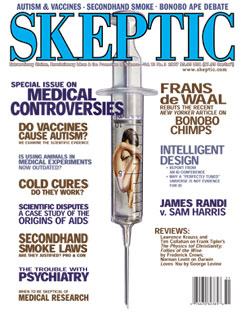
- Animals & Medicine
- Do Animal Experiments
Predict Human Responses?
Thursday, October 4, 2007
CHIMP SHOT DEAD AT ZOO
Chimp shot dead after escaping from U.K. zoo
'No Tunnels Found'
Joseph Brean, National Post
Published: Monday, October 01, 2007Having mysteriously broken free from their "chimpnasium" on Saturday morning, two chimpanzees at a royal zoo in England were faced with a fateful decision: surrender peacefully to their frantic handlers or go for it.
Koko, a female in her thirties, followed a keeper back into the enclosure, bringing to an end her part in the unexplained escape. But 41-year-old Johnny, known to staff as "a bit of a thug," took the road less travelled into the zoo's public grounds, and was promptly shot dead before he could threaten the first visitors of the day, whom staff had just started to shuffle to safety.
Briefly free, he "certainly was not showing any inclination to return," and died from one gunshot wound, according to a zoo spokeswoman. A postmortem was to be conducted.


The British Sunday papers reported that Johnny and Koko tunnelled their way out of their enclosure, and trumpeted the plot's similarity to the 1963 movie The Great Escape, in which Allied soldiers in the Second World War dig their way out of a German POW camp.
But zoo spokeswoman Alice Henchley yesterday denounced the tunnelling theory as mere speculation. "They did not tunnel out of the enclosure," she said. "No tunnels were found."
Staff at Whipsnade Zoo, a 240-hectare suburban partner compound to the much smaller London Zoo, are "devastated," according to zoological director David Field, who also expressed concern for Whipsnade's six other chimps.
The shooting has elicited much sympathy, because chimpanzees, so similar in both appearance and behaviour to humans, have a unique hold on the human imagination.
In Austria last week, for example, a provincial judge dismissed an application to have a 26-year-old male Sierra Leonean chimpanzee legally declared a person, and thus deserving of a court-appointed guardian, now that its shelter has gone bankrupt. Animal rights activists vowed to push the case to Austria's Supreme Court on behalf of the chimp, whom they have named Matthew Hiasl Pan.
Anita Singh, campaigns manager for PETA in London, said Johnny's death is a further illustration that captivity in a zoo frustrates animals and stifles natural behaviours, leading to boredom, anxiety, even self-mutilation.
"They were 30 and 41 years old. For all that time they've been wanting to escape," she said, adding that the zoo should have been able to tranquillize an escaped animal rather than kill it.
Leaving aside King Kong, other chimps on the run include Judy, a former pet who escaped from her cage at an Arkansas zoo this year and proceeded to clean a staff toilet with a scrub-brush; Bill, who fled a California zoo and was recaptured in a nearby backyard; and Chip, who bit off his handler's finger at a Salt Lake City zoo before being tackled and restrained by another keeper.
Though many of these escapes are resolved peacefully, a shooting death remains a likely fate for an escaped zoo animal, largely because human safety is a zoo's primary concern, and tranquillizers are not always instantaneous.
On Boxing Day 2003 at the Toronto Zoo, for example, a gate was accidentally left open and a Siberian tiger escaped into an area that was separated from visitors by only a waist-level fence.
As at Whipsnade, zoo staff had their firearms at the ready, but the situation was resolved by a quick-thinking handler who lured the tiger back into its cage with a chunk of meat.
jbrean@nationalpost.com
© National Post 2007
Thursday, August 30, 2007
Atlanta-relevant; a good teaching & discussion prompt
On Monday, Atlanta Falcons quarterback Michael Vick plead guilty to federal charges of dog fighting, including charges that he personally endorsed the execution of underperforming dogs by hanging or drowning. For insight into the reaction to Vick's case, The New Republic spoke with ethicist Peter Singer, the Ira W. DeCamp Professor of Bioethics at Princeton University. His book Animal Liberation, first published in 1975, is considered the foundational text of the animal rights movement. He discussed the sorry lives of the American pig, the ethical difference between hunting and dog fighting, and why both of those are minor cruelties in the scale of things. What do you make of the public reaction to Michael Vick's involvement in illegal dog fighting? Well, I think in a sense it's quite fair. It seems from the allegation that Michael Vick did horrible things to dogs. If he did what's alleged, people should be disgusted and revolted by it. From my point of view, what is regrettable is that people only react so strongly to such things when they occur with dogs. If something similar had been done with pigs or chickens, the reaction probably would have been much milder. That seems to me to be wrong. I think pigs suffer just as much as dogs, and, in terms of what we do to pigs in this country in general, they suffer a lot more cruelty than dogs do because there are so many of them in factory farms in appalling conditions. That's the incongruity. It's not that there's an overreaction to the Vick business, it's rather that there's an underreaction to what's happening elsewhere. Basketball player Stephon Marbury was widely criticized for telling reporters, "We don't say anything about people who shoot deer or shoot other animals. You know, from what I hear, dog fighting is a sport." Do you think his comparison was valid? Well, the aim of a hunter is to kill the animal with as little pain as possible--or it should be. That's the ethic that you get in sport hunting, at least. I'm not condoning or supporting sport hunting but there is a distinction in that the good hunter will shoot the animal in a vital place where it will drop dead immediately. It won't suffer. It seems pretty clear that the dogs that didn't fight well that Michael Vick and his associates killed were not killed instantly at all. They were drowned, for example. Drowning is obviously a much more distressing death than being shot with a bullet through the brain or in the heart. Has the reaction to the Vick case exposed a schizophrenia in the way the public judges offenses against animals? That comparison that you just asked me to make between dog fighting and sport-hunting is interesting in itself because these are both really very minor cruelties in the terms of the scale of things. The big thing that is going undiscussed here is the industrial raising of animals for food. Just in terms of the numbers, it's so vastly greater than sport-hunting, which in turn is a lot bigger than dog fighting. We're talking literally about billions of animals each year being reared in conditions that don't enable them to have a minimally decent life and then being killed in mass-production factory ways that again often are not painless. So that's the schizophrenia, that all of this hidden suffering that's engaged in by supposedly respectable corporations and that people then buy in their supermarkets is the thing that is unspoken. It's not the recreational activities that we should be focusing on. Has there been an increase of interest in animal cruelty recently? I think so. At the 2006 elections there were a number of animal anti-cruelty initiatives passed. There's been a bit of an upsurge in it and I would say that the response to Vick is consistent with that. People are starting to realize that this is an issue that a lot of people are taking quite seriously now. Perhaps that is going to have some larger political ramifications as well. The TNR Q&A
Of Dog Fights and Men
Only at TNR Online
Post date: 08.29.07

Friday, August 3, 2007
Zoos Reconsidered
Newsweek's commentator Rabbi Marc Gellman has weighed in on the problem of zoos with his piece "Tiger, Tiger: Why it’s time to reconsider the whole notion of putting wild animals in zoos" (Aug. 1, 2007).
Here are a few excerpts:
Do zoos increase environmental consciousness and thus help to protect the habitats of other wild animals? I don't think so. As far as I can tell, the people deforesting the Amazon or killing elephants in Africa for their ivory have not been deterred by outraged kids and their families who just visited the zoo.
I just finished watching the Discovery Channel’s “Planet Earth” in all its high-definition spectacularness. It does more to show animals in their natural environment, behaving as they really behave in the wild than any zoo ever could. True, you cannot smell them, and true, there is an unforgettable size and savor to elephant dung, but in these new breathtaking images, we humans can see animals without imprisoning them.
Gellman's essay is in the Newsweek issue focusing on trapping of gorillas.
Here are a few excerpts:
Do zoos increase environmental consciousness and thus help to protect the habitats of other wild animals? I don't think so. As far as I can tell, the people deforesting the Amazon or killing elephants in Africa for their ivory have not been deterred by outraged kids and their families who just visited the zoo.
I just finished watching the Discovery Channel’s “Planet Earth” in all its high-definition spectacularness. It does more to show animals in their natural environment, behaving as they really behave in the wild than any zoo ever could. True, you cannot smell them, and true, there is an unforgettable size and savor to elephant dung, but in these new breathtaking images, we humans can see animals without imprisoning them.
Gellman's essay is in the Newsweek issue focusing on trapping of gorillas.
Friday, July 6, 2007
A Talk by Lori Marino

Time to apply the Golden Rule to other species
July 5, 2007 : 10:04 AM ET
Best Friends News
What if an elephant believed humans were created to live in a small cubicle for life specifically to entertain all their elephant friends?
What if a pod of dolphins thought it would be fun to trap a couple of kids and forced them to perform tricks for their dolphin families and buddies for the rest of their natural lives?
And what if a couple of chimpanzees decided the couple of humans standing nearby would make great subjects for medical experiments?
That would be wrong, wouldn’t it? So why is it OK for humans to trap elephants, capture dolphins and force them into captivity and deem apes perfect fodder for medical experiments?
According to Dr. Lori Marino, the answer is simple: Because we don’t think of other species as our equals. As a result, we are in danger of looking at the extinction of nearly 16,000 species.
So what’s the solution? That’s simple, too: Think differently.
“We have to step outside ourselves to get a better view of what we’re doing,” she said. “Otherwise, we’re effectively going to continue killing off the planet.”
Lori is a senior lecturer in neuroscience and behavioral biology at Emory University. She teaches animal welfare, brain imaging and comparative neuroanatomy – the study of the similarities and differences between species.
She recently gave a presentation at Best Friends on trans-species psychology, an emerging discipline developed by Lori’s colleague Gay Bradshaw. TSP recognizes that all species undergo the same dynamics, emotional pain and joy, and social experiences most people currently understand as uniquely human.
“We have to change the way we think of other species,” Lori said. “It shouldn’t be, ‘What are they?’ but ‘Who are they?’ The more we connect ourselves, the less likely we are to do them harm.”
Lori focused on cetaceans, elephants and chimpanzees: how their lives would play out naturally and how humans intervene to alter – actually damage – their natural life course. She noted that on a general level we share complexity, individuality and higher order continuity with the other species. We have large complex brains, self-awareness, long childhoods and individual roles to play in society. So do dolphins, whales and elephants. We have the capacity to love, play, help each other, baby-sit each other’s children and learn from our elders. Ditto the dolphins, whales and elephants.
If we’re so similar, who are we, as humans, to decide how they live their lives? How would we respond if we were the ones held in captivity, relocated without reason or poached for entertainment?
“This is where we must begin,” Lori said. “These creatures are our equals. We need to start treating them the way we would treat our fellow human beings, and it all begins with changing the way we think.”
If we thought differently, maybe we wouldn’t engage in drive hunts for dolphins. We wouldn’t force them into shallow waters, throw nets over them, kill some and save some for trainers because we’d know we wouldn’t want that done to us.
“Dolphins are very social creatures. They form families and social groups. They hold fins to express affection the way we hold hands,” Lori said.
She explained that dolphins engage in cultural traditions – activities handed down by elders like strand-feeding and sponge-carrying. How different is that from a mother teaching her child how to use a spoon and fork? Male dolphins get together to engage in synchronized swimming and diving, much in the same way young boys get together to play sports. And if a baby dolphin is taken from his mom too early, he likely won’t survive because he needs her to learn how to be a dolphin. Just like baby boys and girls couldn’t survive without their moms.
If we thought differently, maybe we wouldn’t treat chimpanzees as medical experiments.
“We share over 98 percent of our DNA with chimpanzees; they are our closest living relative,” Lori said.
Just like us, chimpanzees live in groups that sometimes stay together, sometimes break apart. The “head honcho” chimps enjoy being groomed by their peers, the ultimate expression of respect. They like a comfortable bed of leaves to sleep on every night. They fight, wage war and make love.
And then the humans come in, take them from their families and friends, and put them in cages with concrete slabs for our own purposes because we don’t think we’re pulling them from a social fabric, from love, from comfort.
If we thought differently about other species, maybe we’d think twice about moving elephants from one place to another. And this point is particularly interesting because we often move them because we think it’s in their best interest, in the interest of conservation.
“My colleagues have shown that male elephants look to older males to learn how to be successful adult males in their society,” Lori said. “Without an adult male around, the younger elephants experience abnormal development and hyper-aggression.”
If an adult male is relocated and leaves young males behind, there’s no way for the youngsters to learn how to behave. The orphans form gangs and grow into angry, aggressive and dangerous adults. Much like young boys who don’t have a father figure to look up to.
Lori then quoted some frightening statistics. Last year, the Chinese River Dolphin became extinct due to human activities in its habitat. Currently, there are nearly 16,000 species of plants and animals running a very high risk of extinction. In the 1900s, 10 million elephants roamed the plains of Africa. Now there are less than 500,000. The worldwide population of all the remaining great apes (chimpanzees, bonobos, gorillas and orangutans) could fit into a football stadium. And a great deal of this decline can be directly traced to the behavior of humans.
So where do we begin to change this ominous trend?
“Let’s start with the children,” Lori said. “Let’s teach them to understand our place in the universe is the same place as all living creatures. Let’s teach them not to make the mistakes we made.
“And it’s not too late for us. We need to make the changes within ourselves. There’s no time like the present.”
More information may be found at the following websites:
International Association for Animal Trauma and Recovery http://iaatr.org/
Kerulos Centre for Animal Psychology and Trauma Recovery http://www.kerulos.org/
Act For Dolphins – Stop the Dolphin Slaughter in Japan http://green-alien.com/ACT/
Project R&R-Release and Restitution for Chimpanzees in U.S. Laboratories http://www.releasechimps.org/
Written by Amy Abern
Thursday, June 21, 2007
AJC Opinion

Aquarium should admit captivity hurts these fish
Atlanta Journal Constitution
Published on: 06/15/07
We are saddened and disturbed by the untimely death of Norton, the second whale shark to succumb while in the custody of the Georgia Aquarium.
The aquarium justifies holding whale sharks for the purpose of educating the public, preserving endangered animals and conducting research. None of these points holds water.
The aquarium has produced no credible evidence that visits to their whale shark exhibit (or any other exhibit, for that matter) translate into better understanding of whale sharks (or any other species).
Looking at these animals in downtown Atlanta may seem educational, or at least, harmless, but in fact it teaches us exactly the wrong ecological lessons.
Instead of cultivating our understanding of the importance of an animal's habitat (and thus, the need to stop desecrating the oceans with the runoff from our industrial and commercial activities), aquarium displays suggest that habitats are irrelevant to the animal's well-being. Perhaps the most important fact about whale sharks is that they are classified as a vulnerable species (only one step better than endangered) by the International Union for the Conservation of Nature and Natural Resources.
The Georgia Aquarium has done nothing to "educate" the public about the fact that by purchasing these animals from Taiwanese fishermen, they financially support the very industry that has led to their threatened status.
Whale sharks are so wonderfully mysterious to us: There's so much we don't know about them (how long they live, where they travel, how they feed, how they reproduce, how far they swim, even how many of them there are).
Can't we leave these mysteries unknown and leave the sharks in peace?
Every animal has an innate dignity, and keeping them captive in these tanks is a transgression of that dignity. We aren't meant to see whale sharks in this way: It isn't natural. The whole enterprise of spectatorship, as it takes place at the aquarium, is fundamentally and inherently flawed. If we aspire to honor and understand nature and ecological harmony, then we cannot continue to displace and degrade animals as we have done in the past.
The Georgia Aquarium should step up and do the right thing by admitting that they made a mistake in taking these animals into captivity and stop hiding behind the empty promises of education, conservation and research. They can set an ethical example for the rest of the captivity industry.
It is their choice as to whether they will rise to the occasion.
• Randy Malamud is professor and associate chair of modern literature, ecocriticism, and cultural studies at Georgia State University. Lori Marino is senior lecturer in neuroscience and behavioral biology at Emory University. Contributing to this column were Ron Broglio, assistant professor of literature, communication, and culture at Georgia Tech, and Nathan Nobis, assistant professor of philosophy and religion at Morehouse College.
Subscribe to:
Posts (Atom)